
My memories (variably accurate) of a woman who inspired me.
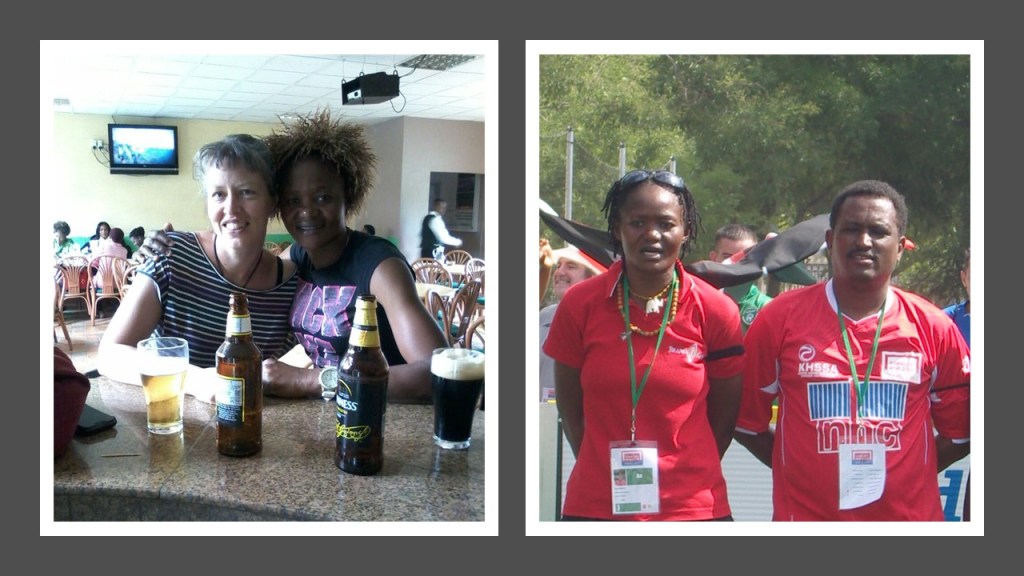
I don’t think Mara was even supposed to be in Paris.
Kenya sent a men’s team and a women’s team to the Homeless World Cup. The logistics involved in the event were incredible – visas, permissions, flights, accommodation and funding. And certain amounts of funding were raised and certain permissions were obtained for the different teams. Mara was not on the list for the Kenya team, but there she was. There she was.
And what can you do?
That was the first time I met Mara.
I had lived in Kenya for a while. I had lots of Kenyan friends. I was back and forth to Kenya a lot, so I did feel a connection with that Kenya team. And they were so full of energy and just loving this unexpected opportunity to be in Paris.
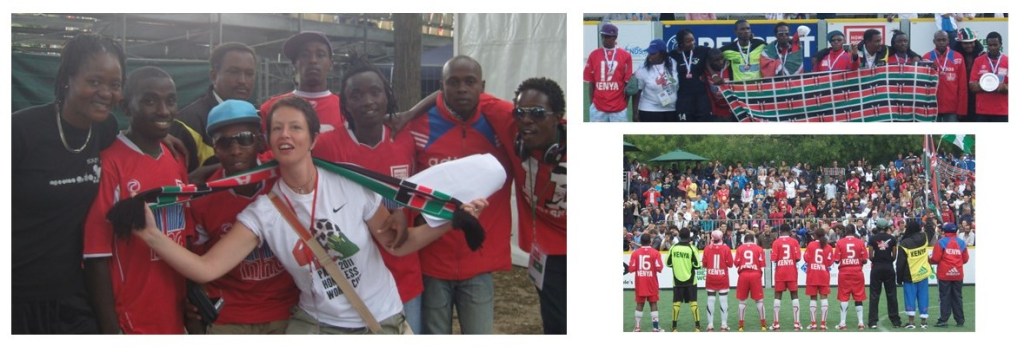
I think the place they were staying was a bit out of the city, and I remember Mara being amazed and delighted that – I still don’t understand what this was about – every day when they went outside their accommodation early in the morning, they would find on the street bags full of clothes that people living in the area had put out. And so they took those clothes and they took them back to their accommodation. And it was like Christmas everyday. Mara and the other members of the Kenyan delegation were very well clothed during their time in France.
The next time I saw Mara was in her home environment, Dandora dumpsite, Nairobi. I’d gone there because I was helping the Kenya Street Soccer Association to develop a monitoring and evaluation strategy that would help them hopefully to get more funds. And we were doing this together, so I met with Mara and the others several times over a couple of weeks.
But the first time I went to Dandora, it was a shock. I’d been in Kenya on and off for years, but I’d never visited anywhere like Dandora. It was basically a massive rubbish dump. People lived on the rubbish dump. Mara and some of the others from the teams that had been in Paris, including a young man called Toronto, showed me all around. They lent me welly boots so that I could go on the dumpsite itself. People had built small sort of shelters and were living on the dump site. I saw used syringes and blood packs from hospitals just lying around. Searching through the rubbish for things they could sell. Crawling over this stuff, this dirty, dangerous stuff, looking for things they could sell.
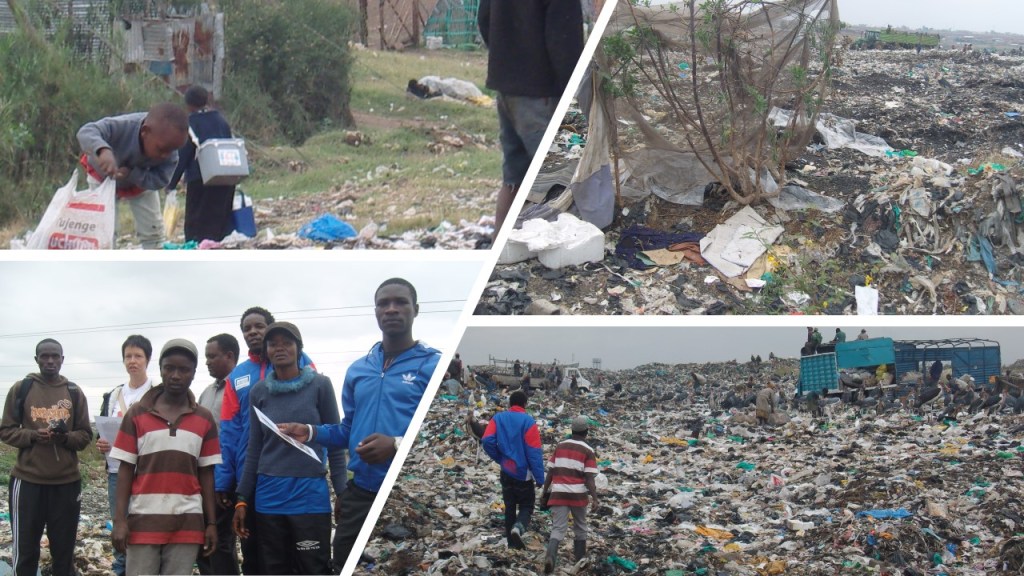
I heard about the highlight of the days in Dandora, which was when the airlines came to dump all their rubbish, because often there would be the airline food packs that had not been eaten. And so that was like a food delivery for some people there. They showed me all those horrible things. They took me over the rubbish dump down to the river where there were men brewing changaa, local brew, which was of a strength that I’m sure I couldn’t have survived but which got some people through the days.
Not everyone, of course, lived actually on the rubbish dump. There was what we would call now an informal settlement at the side, and that was where Mara lived. But she told me during that trip that she and her sister had moved to the dumpsite as teenagers after their mother died. Mara was living on the rubbish itself. She worked as a sex worker. She was addicted to changaa. She got pregnant. She had a baby girl. She played football. She started teaching the younger ones to play football. She trained as a referee and started making some money refereeing other matches. She stopped working as a sex worker. She stopped with the changaa. She moved off the rubbish dump and lived in a room at the side. She coached younger kids in football. She refereed. She brought up her girl.
She took me to the place where she lived now, a couple of rooms lined with trophies to mark her footballing and refereeing successes. There were always loads of little kids hanging around. She was teaching them football, and maybe other stuff too, I don’t know. Her name wasn’t Mara, of course. Her name was Rosemary, Rosemary Aluoch. She was called Mara after Maradona. Hand of God.
After that trip Mara and I stayed in touch. I was in Kenya regularly, probably every six months or so with different jobs. Every time I was in Kenya I went down to Dandora. I was in touch with Toronto too. He wanted to learn computers so I gave him some money for that, and he was going to classes.
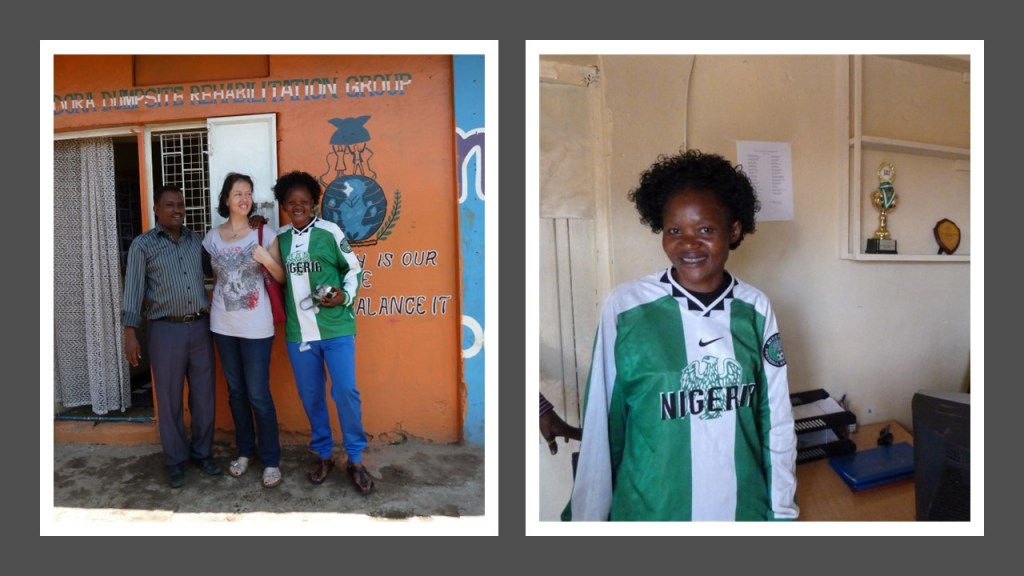
Mara never had the chance to finish school when she was young, and really wanted to, so I paid for her to go back to school as an adult to get her school certificate. She was very proud of doing that – one time I visited she took me to the school and introduced me to the head teacher. At the same time she was refereeing the Kenyan Football League matches. She was still teaching kids and with a couple of other people she had started DADREG, Dandora Dumpsite Rehabilitation Group. They got a small place for an office at the side of the dumpsite. By the time I visited the building was painted outside with ‘Dandora Dumpsite Rehabilitation Group’, and inside they had shelves, a desk, a computer. They were not only teaching football but other things – hairdressing classes, vocational training, bakeries.
Mara was still going to school, still refereeing and also bringing up her daughter. She graduated successfully from school and DADREG was growing. She often emailed to ask me to write a letter of support as they applied for funding to develop DADREG further, and the organisation became more and more successful. One time I visited when they were running a massive football tournament, with hundreds of kids involved. I sat at the top table with Mara and others, with all the trophies lined up on the table ready to be presented to the winning teams, and there was such an atmosphere, such a positive buzz around the place.
Mara and her friends created that feeling, that positivity. When they went to Paris with the Homeless World Cup in 2011, it started something. It had created a feeling that anything was possible and Mara was surfing on that feeling. She got involved with the Kenya National women’s football team, the Harambee Starlets, and became the goal keeping coach for them. She travelled. On Facebook I saw photos of her in airports with the Kenya Starlets, going all over Africa for the Africa Cup of Nations.
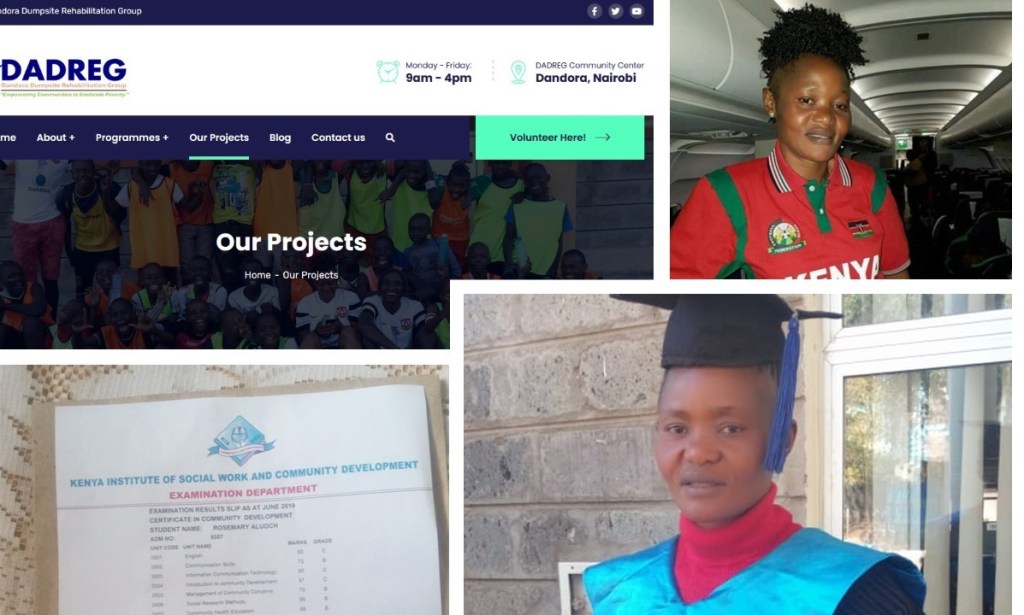
She wanted to get a diploma in Community development. Who could make better use of those skills than Mara? She was already doing it. I was very happy to pay for that, so I did.
Toronto had finished his computer classes, and tried to set up some kind of computer business. But he had been shot dead by the police during an armed robbery. Shocking for me, and heartbreaking for his friends and family, including his wife and two young twins. Crime must have been a risk for anyone living in that environment, but Mara seemed to have avoided that danger, she was so focused on what she wanted to achieve.
DADREG was doing amazing things – teaching bakery, still doing football, hairdressing, all kinds of different vocational things. Giving people in Dandora dumpsite a sense that something was possible. They saw Mara, saw her travel all over Africa and beyond with the Harambee Starlets. This was possible for someone who grew up on the dumpsite, someone who had lived on the rubbish, been addicted to changaa – look at her now.
Every time I was in Kenya I went to visit her. She was very demanding. There were constant whatsapps – she needs this, she needs that. She used to call me Mum – I hated it. I’m not your mother. I didn’t want that responsibility, but she would not stop. She needs money for this, her daughter needs glasses, they don’t have food, duh duh, duh, duh, duh. Constant. I didn’t believe she didn’t have food, she was so enterprising, she could always find a way to get by. That’s what I thought. So I just started to feel like, oh, this is a bit oppressive.
I never was sure about Mara. She had learned to survive, she’d use people and opportunities that would help her, and would help other people in Dandora. Her goals were bigger than herself. Mara had big goals, big dreams.
She graduated from the community development diploma course successfully in October 2019. I’d not seen her for a while by then, because my work wasn’t taking me to Kenya as often as it had been. Even when I had been in the country, it was kind of tiring to be going to Dandora. I usually went there with other people I’d met through the Kenya Street Soccer Association, and these people had become very difficult for me to be around, so I’d deliberately stopped contact with them. I found it hard to get to Dandora on my own on public transport, although I did do it once or twice.
So I didn’t see Mara for a few years, although we stayed in touch through WhatsApp and I saw what she was up to on Facebook.
It got to February 2020, and she wanted me to send money. I didn’t send money. I was tired. When you don’t see someone for a while, you can forget why you’re friends sometimes, especially when that person seems to want a lot from you, you forget the good parts. And it just feels like a drain. So I suppose my responses got shorter or weren’t there at all. All her interactions with me were mostly about things she needed from me, or how much she depended on me, ‘I love you Mum. You’ve helped me so much’, and I didn’t like it.
Then she was sick. She didn’t tell me she was sick, it was one of her colleagues at DADREG who told me she was in hospital, George. They didn’t know what the problem was. I seem to remember meningitis was mentioned, maybe. This was all at the beginning of the COVID pandemic, I’d lost all my work and everyone was struggling. I’m not sure I paid so much attention. But then George contacted me. He said she seemed to be improving, she couldn’t walk but she could sit up, and they were hoping to get her discharged the following week. So I sent some money to pay for some of the hospital fees so they could discharge her. The next thing, only a week later or even less, I hear from George that she died. I don’t know what happened. I don’t know what the sickness was. But it seemed incredible that the force of nature that was Mara just died, I did not expect that.
And it hurt me.
She was a person I was proud to know. I was proud to have supported her through school and through the diploma. Watching her fly, watching what she did with DADREG. She was really doing something amazing. She was keeping all the balls in the air, showing people on the dump site – this is possible, look at this! And she never left the dumpsite, she still lived there working for the Harambee Starlets. She was committed to DADREG, to her community. How could that person be gone? Of all the people. How old would she have been? Maybe around 40 by the time she died. And what she could have achieved, what she did achieve in her life, more than most of us would achieve ever. She made that happen.
I feel sad.
I didn’t recognise what a force she was. Or to be honest, what’s more true is that I did recognise what a force she was and that’s why I withdrew. She would bulldoze through anybody to get what she needed and I was one of those people she would bulldoze through for sure. Whatever I gave it would never be enough. Mara was aiming for the moon, the stars and the universe. What could ever be enough for her? But what a privilege for me, to be a little part of the journey of that shooting star.
 Unfurl /ŭn-fûrl′/