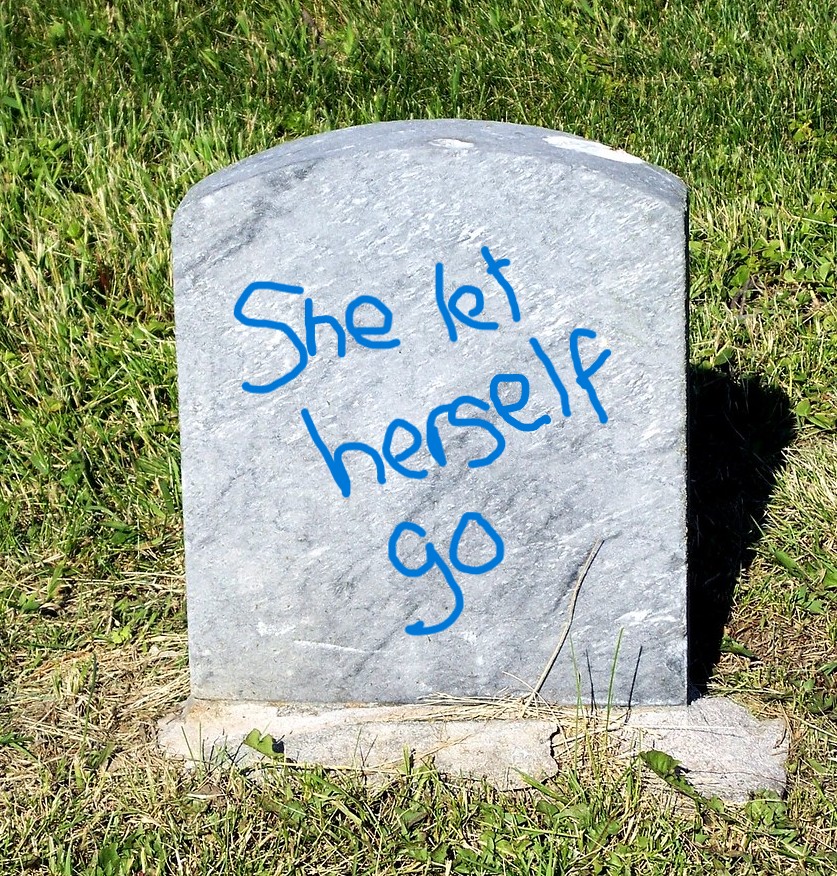
That’s what I’d like to be written on my headstone, if I have one.
Insults fired at a person, especially to women, are often not actually insults. ‘She’s so full of herself’. ‘She really thinks she’s something’. Well, yes, I am 100% full of myself, with very little space left over for other people’s opinions and judgements on that (thanks Jo Hutton for this!). I’m also working quite hard on letting myself go. I’ve been holding myself in for long enough now, trying to look reasonably acceptable, be a good girl in all kinds of ways, and generally twist myself into knots trying not to offend anyone or frighten the horses.
It’s going to take me a while, but I do hope that by the time comes for me to order my headstone (if I have one), I’ll be able to confidently have ‘she let herself go’ carved into stone.
Even before I put my house on AirBnB, I had some niggles which I turned away from and refused to look at. I had decided to go ahead, and that’s what I did. In the year since, those niggles haven’t gone away – in fact they’ve been joined by new ones. They aren’t concerns about my allowing others to live in my home for a few days – I was never too concerned about people not respecting my space, or stealing things, or trashing my home, and in fact none of those things have happened. I’ve used AirBnB for my own trips for more than 10 years, and have always had good interactions with hosts, so I expected the same when I became a host. I made sure always to have a bit of back-and-forth chat with a person who had requested to book my home, and turned down anyone I got a bad vibe from. My house isn’t city centre, so doesn’t really attract party lovers, it’s often been people who are visiting family in the area, or who come to visit the beach and the Antony Gormley iron men, or want to visit Liverpool but stay away from the bustle, in a more community-type area.
One of the immediate benefits of putting my house on the AirBnB site was that I fell back in love with the place where I live. I moved here in 2011, and chose the area almost at random. I was moving back to the north-west from Edinburgh and had been nomadic and ungrounded for so long, I had no reason to live anywhere in particular. I didn’t want to be too far from my parents, so I’d be around if they needed me as they got older (14 years later, I’m still not needed ….) but that still left a big area within the region I’d grown up in and spent most of my life in until I was 35. I chose Waterloo because it was close to the sea, close to Liverpool, where I felt as at home as I did anywhere, and had great public transport links so I didn’t need to get a car.
Until the pandemic, I hardly spent any time at home, it was just a base for me to keep my stuff while I jetted off to wherever my work took me. When I was grounded by the pandemic, I grew to love my home. I was so grateful for the little back yard, the friendly neighbours, the local shops that kept things going, and, most of all, the beach and the sea that never stopped doing what it was made to do.
As time went on, the pandemic ended and life returned to a different sort of normal for me, with hardly any travel, I started to feel a bit differently about my home. The friendly connections of lockdown faded away, everyone went back into their own lives and I got new neighbours on one side who were much less friendly. I started to feel an edginess about the area where I live. I knew the edgy side existed, but it never really impinged on me before. Now I started to feel it, and to feel less comfortable, even though nothing had actually changed.
So when I started to write about my home and the area for my AirBnB page, it made me think about what was good. I created a ‘guestbook’ for my home, and listed all the wonderful independent pubs, cafes, shops, restaurants within a 15-minute walk of my house. I told potential visitors about the wonderful park at the end of my road, about the amazing beach with its public art. I took photos of my house from different perspectives, and it looked great. I started to feel proud of my house and my area, and happy to be able to offer it to people looking for somewhere to stay. It felt like a privilege, in fact. Lucky me.
I tested out my house with a friend who stayed while I had to travel for work. I asked her to tell me what was good about staying in the house and what I needed to change. There were just a few things she suggested, and once I’d addressed them I had confidence that the house was ready for visitors. This didn’t stop me being terrified when I had the first people to stay for the weekend – my phone was off mute and right next to me until they left. They left me a very lovely note, but it turned out that one set of keys wasn’t enough. One guest had locked herself out and had to get my neighbour to shout over the fence to ask her husband, who was relaxing with a coffee in the back yard with his phone on silent, to open the front door and let her in. So two sets of keys from now on. And it turned out my house wasn’t as pet-friendly as I thought, since their little dog ate my heather. So no pets from now on. Lessons learned.
As I had more people staying it got easier, and I felt more confident that I’d thought of everything and nothing was likely to go wrong. I had some wonderful reviews on the AirBnB site, as well as lovely interactions with people when I met them to hand over the keys. I’d bought a key-safe but decided against using it. Since it’s my own home, I like to meet the people who stay here, and feel that if they meet me, they’re more likely to be respectful of my home. Many guests are surprised to discover when they arrive that it is my own home. Most assume that it’s a business, which I think says a lot about what AirBnB has become. I can say that everyone I’ve had staying in my house has been lovely. Several have left me plants or little presents, which was totally unexpected, given that they’re paying to stay in my house, but feels good because it makes the whole thing feel a little bit more than purely transactional. I’ve been invited to visit some of the people in their own homes, if I’m ever passing through Nashville or southern Germany or some other wonderful-sounding place.
After my first guests, I hosted one or two groups of visitors a month, until August when I hosted three groups. This was too much. What had begun as a nice, easy way of earning some extra cash that would be set aside for me and my boyfriend, D, to go on holiday or have little trips away, had become a relentless process of cleaning and hardly living in my own home. It became difficult to relax and enjoy being at home because I didn’t want to mess it up. I was aware that I’d only have to clean and tidy everything for the next group, so better just to sit still and not touch anything. After August, once the schools had gone back, there were fewer visitors, but the joy had still gone out of it for me, so when someone tried to book for over the Christmas period I considered it but decided I wanted my home back, so declined that request and blocked out my AirBnB calendar entirely for December and January.
During that time, I took stock. I have a job and earn enough not to need to also rent out my house. This was intended to be extra money, for extras. It was a source of joint money for me and D, since I stayed with him while guests were in my house, and we could use it to do nice things we wouldn’t otherwise be able to afford. The cleaning for each set of visitors can be exhausting, if I try to fit it around everything else I need to do. But if I’m able to dedicate a day to it, and do it slowly whilst listening to a podcast or the radio, I actually enjoy it. And I have the pleasure of living in a clean house once the visitors have left – much cleaner than it would be if I didn’t have paying guests arriving. I love the pleasure that people take in my house, and their appreciation for the things I’ve done to try to make sure they’re comfortable and happy staying here. So I decided I didn’t want to stop entirely, but just to manage the number of visitors I have. About once a month felt right.
I also realised that I need to take a bit more control over the booking process. Previously, I kept my calendar open and if people asked to stay then I would consider whether it was possible, and sometimes would have to decline because it clashed with another commitment of some kind. I hated declining a request, I found it incredibly hard, so sometimes said yes and then regretted it. If someone asks me for something, I want to say yes. This has been an interesting observation for me, and is something I’ll think about more, but in relation to AirBnB I managed it by blocking out my calendar for any period when a visitor would be inconvenient for me. Also, once I had a booking, I would block out the whole of the rest of that month, so that I wouldn’t have more guests than I felt comfortable with.
I had a third learning experience, more recently. Liverpool is a city where events happen, and this brings visitors. I had three young women staying in my house who had, amazingly, come from the US to see Taylor Swift at Anfield. I had people working at Aintree races staying over the Grand National weekend. I’ve had three young people who had created a wedding planning app staying here while they were promoting it at a big wedding fair in the city centre, and four young people from Darlington who were here for a ComicCon event. All were a delight! But once it became clear that Liverpool FC were likely to win the league, and the victory parade would take place on 26 May, I was contacted by a stream of people who wanted to book my house and were less than delightful. I like to have a bit of a chat with people before I accept their booking, and I steer clear of people with no reviews, because I need to feel comfortable with whoever I allow to stay in my home, and the people who were trying to book for this particular weekend were often really unpleasant about this, with one being exceptionally abusive and subsequently banned by AirBnB. This all came as a shock to me, because I hadn’t experienced it before – this was a very different population to those who usually want to book my place. Once I realised what was going on, I blocked out that whole period on my calendar, so nobody could request to book, but it did leave me feeling shaken up.
Which brings me back, I suppose, to my more fundamental niggles with AirBnB. One is that the model has so clearly caused problems in some places. Whilst I’m renting out my own home, and I’ve stayed in other AirBnBs which have been the host’s main residence, the majority seem to be business investments. When good rented housing is so difficult to come by, AirBnB is exacerbating the problem, and creating areas where there is no community at all, just a transient population of visitors. Secondly, AirBnB rent out homes which are illegally located on Palestinian land in the West Bank. There is clearly no moral compass underpinning the company’s activities – it’s a purely money-making initiative, even if it didn’t start out that way. The moment when I couldn’t look away from this any more was when I saw the AirBnB co-founder amongst the acolytes at Trump’s inauguration. Now I learn he’s part of the team that have devastated humanitarian aid budgets, amongst other disasters. This really makes me question what I’m doing, and whether I want to contribute to this business, even if the flexibility and convenience of it suits me.
I began AirBnBing my house with enthusiasm, and the experience has gifted me in many ways. It’s made me very much appreciate my home and the area I live in, and I do love sharing it with others who also get pleasure from it. A year into my AirBnB experience, though, I’m not so sure it’s the best way for me to share the delights of my home. I think the time might have come to explore house-exchange sites instead.
My memories (variably accurate) of a woman who inspired me.
I don’t think Mara was even supposed to be in Paris.
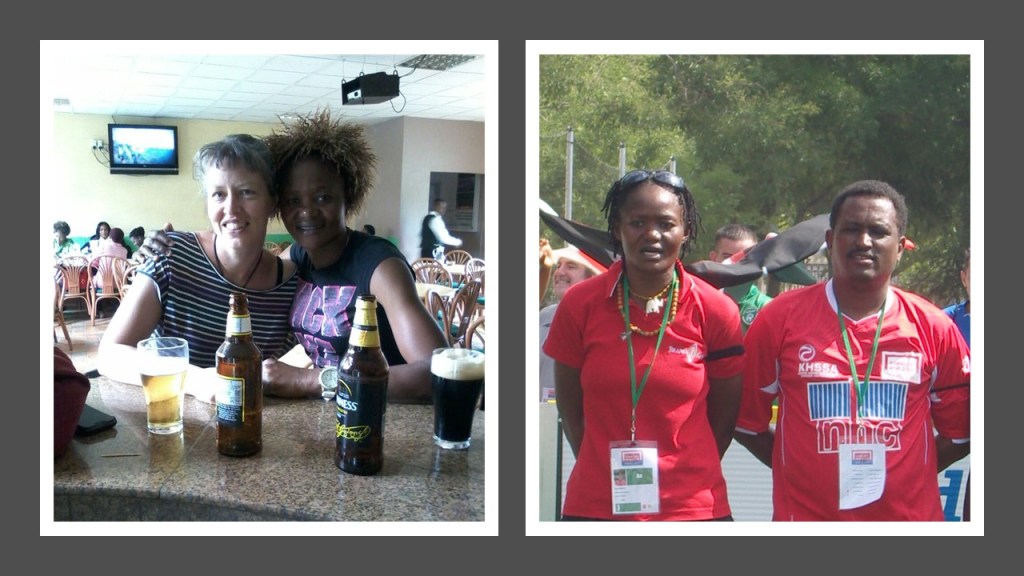
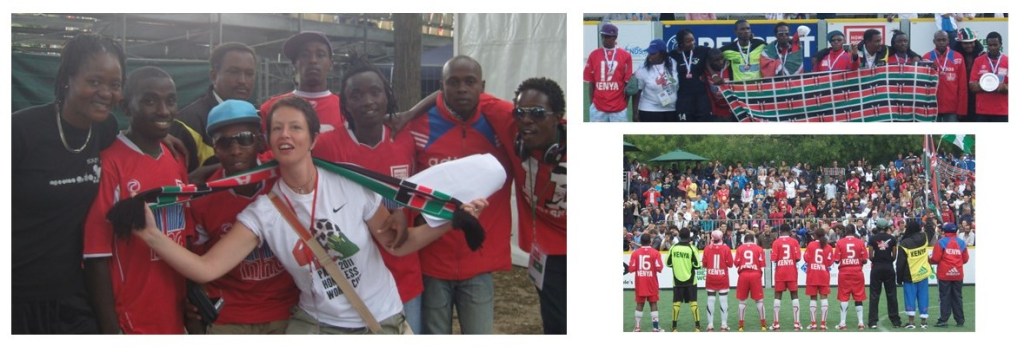
Kenya sent a men’s team and a women’s team to the Homeless World Cup. The logistics involved in the event were incredible – visas, permissions, flights, accommodation and funding. And certain amounts of funding were raised and certain permissions were obtained for the different teams. Mara was not on the list for the Kenya team, but there she was. There she was.
And what can you do?
That was the first time I met Mara.
I had lived in Kenya for a while. I had lots of Kenyan friends. I was back and forth to Kenya a lot, so I did feel a connection with that Kenya team. And they were so full of energy and just loving this unexpected opportunity to be in Paris.
I think the place they were staying was a bit out of the city, and I remember Mara being amazed and delighted that – I still don’t understand what this was about – every day when they went outside their accommodation early in the morning, they would find on the street bags full of clothes that people living in the area had put out. And so they took those clothes and they took them back to their accommodation. And it was like Christmas everyday. Mara and the other members of the Kenyan delegation were very well clothed during their time in France.
The next time I saw Mara was in her home environment, Dandora dumpsite, Nairobi. I’d gone there because I was helping the Kenya Street Soccer Association to develop a monitoring and evaluation strategy that would help them hopefully to get more funds. And we were doing this together, so I met with Mara and the others several times over a couple of weeks.
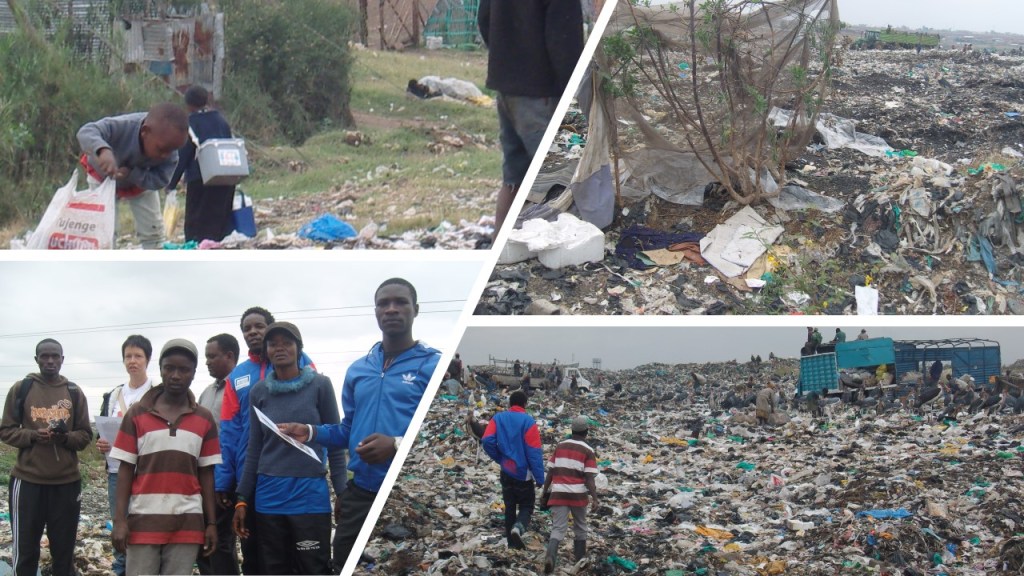
But the first time I went to Dandora, it was a shock. I’d been in Kenya on and off for years, but I’d never visited anywhere like Dandora. It was basically a massive rubbish dump. People lived on the rubbish dump. Mara and some of the others from the teams that had been in Paris, including a young man called Toronto, showed me all around. They lent me welly boots so that I could go on the dumpsite itself. People had built small sort of shelters and were living on the dump site. I saw used syringes and blood packs from hospitals just lying around. Searching through the rubbish for things they could sell. Crawling over this stuff, this dirty, dangerous stuff, looking for things they could sell.
I heard about the highlight of the days in Dandora, which was when the airlines came to dump all their rubbish, because often there would be the airline food packs that had not been eaten. And so that was like a food delivery for some people there. They showed me all those horrible things. They took me over the rubbish dump down to the river where there were men brewing changaa, local brew, which was of a strength that I’m sure I couldn’t have survived but which got some people through the days.
Not everyone, of course, lived actually on the rubbish dump. There was what we would call now an informal settlement at the side, and that was where Mara lived. But she told me during that trip that she and her sister had moved to the dumpsite as teenagers after their mother died. Mara was living on the rubbish itself. She worked as a sex worker. She was addicted to changaa. She got pregnant. She had a baby girl. She played football. She started teaching the younger ones to play football. She trained as a referee and started making some money refereeing other matches. She stopped working as a sex worker. She stopped with the changaa. She moved off the rubbish dump and lived in a room at the side. She coached younger kids in football. She refereed. She brought up her girl.
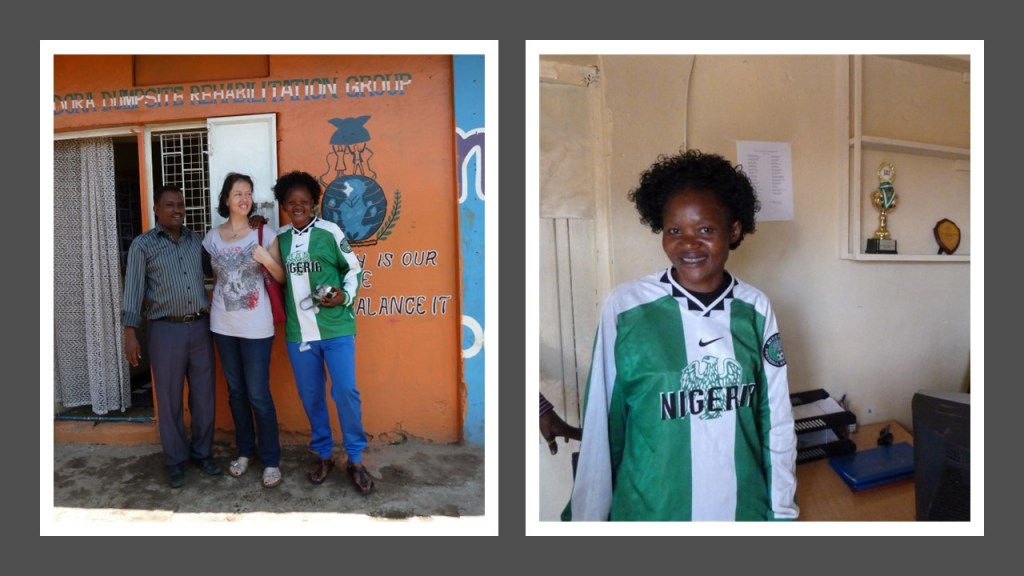
She took me to the place where she lived now, a couple of rooms lined with trophies to mark her footballing and refereeing successes. There were always loads of little kids hanging around. She was teaching them football, and maybe other stuff too, I don’t know. Her name wasn’t Mara, of course. Her name was Rosemary, Rosemary Aluoch. She was called Mara after Maradona. Hand of God.
After that trip Mara and I stayed in touch. I was in Kenya regularly, probably every six months or so with different jobs. Every time I was in Kenya I went down to Dandora. I was in touch with Toronto too. He wanted to learn computers so I gave him some money for that, and he was going to classes.
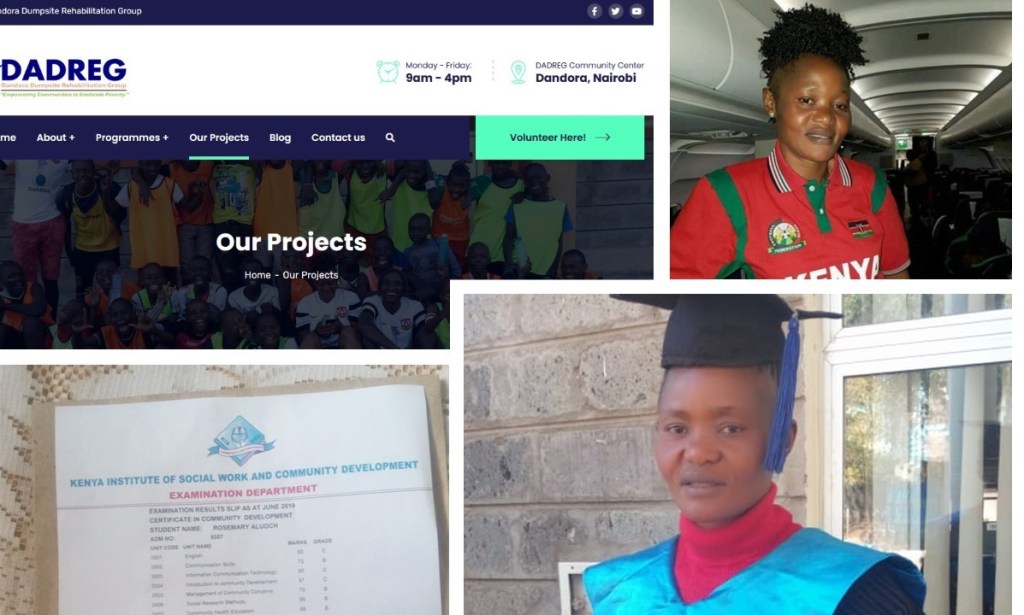
Mara never had the chance to finish school when she was young, and really wanted to, so I paid for her to go back to school as an adult to get her school certificate. She was very proud of doing that – one time I visited she took me to the school and introduced me to the head teacher. At the same time she was refereeing the Kenyan Football League matches. She was still teaching kids and with a couple of other people she had started DADREG, Dandora Dumpsite Rehabilitation Group. They got a small place for an office at the side of the dumpsite. By the time I visited the building was painted outside with ‘Dandora Dumpsite Rehabilitation Group’, and inside they had shelves, a desk, a computer. They were not only teaching football but other things – hairdressing classes, vocational training, bakeries.
Mara was still going to school, still refereeing and also bringing up her daughter. She graduated successfully from school and DADREG was growing. She often emailed to ask me to write a letter of support as they applied for funding to develop DADREG further, and the organisation became more and more successful. One time I visited when they were running a massive football tournament, with hundreds of kids involved. I sat at the top table with Mara and others, with all the trophies lined up on the table ready to be presented to the winning teams, and there was such an atmosphere, such a positive buzz around the place.
Mara and her friends created that feeling, that positivity. When they went to Paris with the Homeless World Cup in 2011, it started something. It had created a feeling that anything was possible and Mara was surfing on that feeling. She got involved with the Kenya National women’s football team, the Harambee Starlets, and became the goal keeping coach for them. She travelled. On Facebook I saw photos of her in airports with the Kenya Starlets, going all over Africa for the Africa Cup of Nations.
She wanted to get a diploma in Community development. Who could make better use of those skills than Mara? She was already doing it. I was very happy to pay for that, so I did.
Toronto had finished his computer classes, and tried to set up some kind of computer business. But he had been shot dead by the police during an armed robbery. Shocking for me, and heartbreaking for his friends and family, including his wife and two young twins. Crime must have been a risk for anyone living in that environment, but Mara seemed to have avoided that danger, she was so focused on what she wanted to achieve.
DADREG was doing amazing things – teaching bakery, still doing football, hairdressing, all kinds of different vocational things. Giving people in Dandora dumpsite a sense that something was possible. They saw Mara, saw her travel all over Africa and beyond with the Harambee Starlets. This was possible for someone who grew up on the dumpsite, someone who had lived on the rubbish, been addicted to changaa – look at her now.
Every time I was in Kenya I went to visit her. She was very demanding. There were constant whatsapps – she needs this, she needs that. She used to call me Mum – I hated it. I’m not your mother. I didn’t want that responsibility, but she would not stop. She needs money for this, her daughter needs glasses, they don’t have food, duh duh, duh, duh, duh. Constant. I didn’t believe she didn’t have food, she was so enterprising, she could always find a way to get by. That’s what I thought. So I just started to feel like, oh, this is a bit oppressive.
I never was sure about Mara. She had learned to survive, she’d use people and opportunities that would help her, and would help other people in Dandora. Her goals were bigger than herself. Mara had big goals, big dreams.
She graduated from the community development diploma course successfully in October 2019. I’d not seen her for a while by then, because my work wasn’t taking me to Kenya as often as it had been. Even when I had been in the country, it was kind of tiring to be going to Dandora. I usually went there with other people I’d met through the Kenya Street Soccer Association, and these people had become very difficult for me to be around, so I’d deliberately stopped contact with them. I found it hard to get to Dandora on my own on public transport, although I did do it once or twice.
So I didn’t see Mara for a few years, although we stayed in touch through WhatsApp and I saw what she was up to on Facebook.
It got to February 2020, and she wanted me to send money. I didn’t send money. I was tired. When you don’t see someone for a while, you can forget why you’re friends sometimes, especially when that person seems to want a lot from you, you forget the good parts. And it just feels like a drain. So I suppose my responses got shorter or weren’t there at all. All her interactions with me were mostly about things she needed from me, or how much she depended on me, ‘I love you Mum. You’ve helped me so much’, and I didn’t like it.
Then she was sick. She didn’t tell me she was sick, it was one of her colleagues at DADREG who told me she was in hospital, George. They didn’t know what the problem was. I seem to remember meningitis was mentioned, maybe. This was all at the beginning of the COVID pandemic, I’d lost all my work and everyone was struggling. I’m not sure I paid so much attention. But then George contacted me. He said she seemed to be improving, she couldn’t walk but she could sit up, and they were hoping to get her discharged the following week. So I sent some money to pay for some of the hospital fees so they could discharge her. The next thing, only a week later or even less, I hear from George that she died. I don’t know what happened. I don’t know what the sickness was. But it seemed incredible that the force of nature that was Mara just died, I did not expect that.
And it hurt me.
She was a person I was proud to know. I was proud to have supported her through school and through the diploma. Watching her fly, watching what she did with DADREG. She was really doing something amazing. She was keeping all the balls in the air, showing people on the dump site – this is possible, look at this! And she never left the dumpsite, she still lived there working for the Harambee Starlets. She was committed to DADREG, to her community. How could that person be gone? Of all the people. How old would she have been? Maybe around 40 by the time she died. And what she could have achieved, what she did achieve in her life, more than most of us would achieve ever. She made that happen.
I feel sad.
I didn’t recognise what a force she was. Or to be honest, what’s more true is that I did recognise what a force she was and that’s why I withdrew. She would bulldoze through anybody to get what she needed and I was one of those people she would bulldoze through for sure. Whatever I gave it would never be enough. Mara was aiming for the moon, the stars and the universe. What could ever be enough for her? But what a privilege for me, to be a little part of the journey of that shooting star.
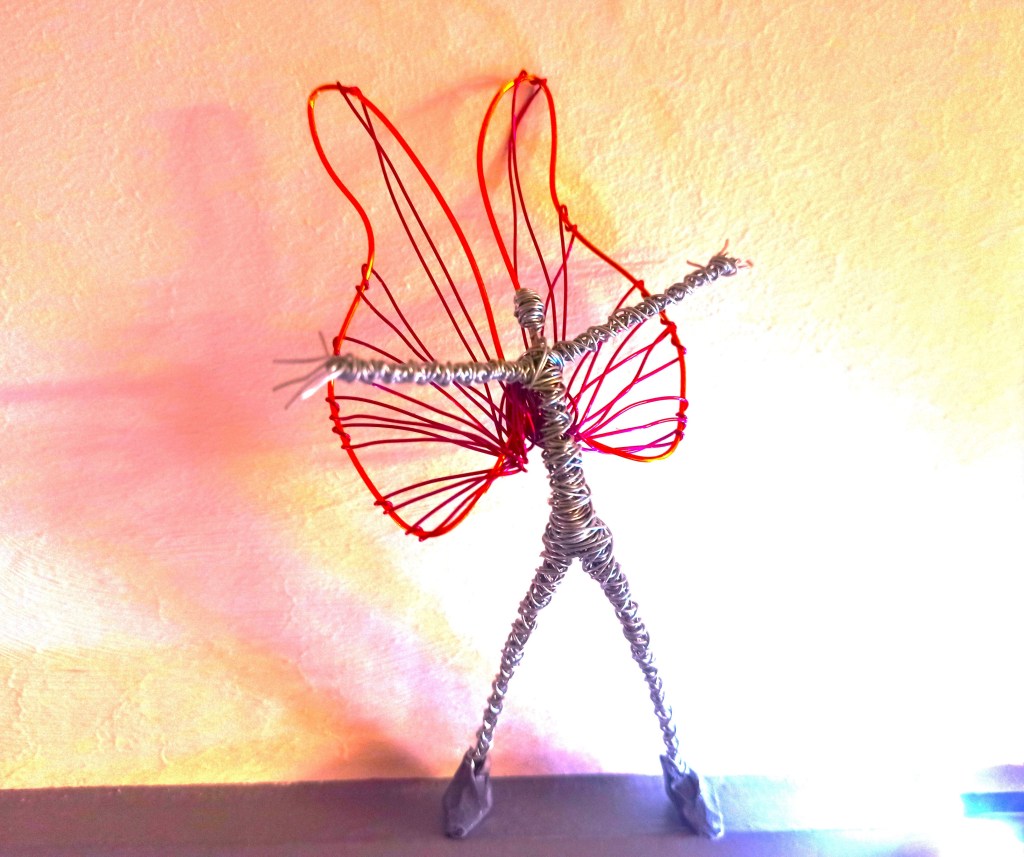
Exuberant wire figure I bought myself to celebrate my 50th birthday
I woke up thinking about you today. It’s a courageous and wonderful thing you’re doing. I can’t imagine you will look back one day and think ‘I wish I’d stayed in that job’. Going freelance turns us into a different type of being, one that there’s no going back from, in my experience.
I woke up thinking about you, but really I was thinking about me. I was remembering the time in 2009 when I decided to give freelance life a go. I was in a different position to you – I’d left my job (and everything else) six years earlier to go and work in a refugee camp. After three years there, and a year working in another overseas job, I came home to the UK and s short-term research fellowship. When that ended, my intention was to get a job in the UK, settle down and build a life having got ‘all that’ out of my system. But I was free – I had nothing and no-one, and it turned out that it was quite difficult to give up that freedom. Also, it was the best chance I had to try working as a freelance Mental Health and Psychosocial Support (MHPSS) specialist. I had nothing to lose.
The first few months were terrifying. I had no work. I spent my days scouring Reliefweb for consultancy projects I might have a chance of getting, going for long runs around Edinburgh and doing yoga. I’d never been so thin or so healthy. Work started coming but the fear didn’t leave. Over the first six or seven years there were periods of no work and no prospect of work. I realised that Jan/ Feb were particularly dry months. I spent the start of several years in a panic that I would never work again – until I did, of course.
Now, 15 years later, it’s different. I do less work and get paid more for it. I only work with people I know and like, people and organisations with values aligned with my own. Mostly I don’t need to look for work – it comes to me. It’s a wonderful position to be in, but it’s taken years to get here. Years of no work, too much work, the wrong kind of work and hardly any life outside of work. This isn’t something I wish for you, but I wouldn’t wish away those years for myself. In fact, they have given me one of the greatest gifts of my freelance life – the confidence that work will always come. This confidence remained despite the loss of all my work when the Covid pandemic hit and I wasn’t able to travel. I was back to scouring Reliefweb for consultancy work I could do remotely, sending off applications that I never heard back from. Until finally one was successful, and I was off again.
My work has changed since then. I don’t want to work as much, and I’m certainly not going back to the impossible travel schedule I had before. But I won’t be giving up the freelance life. It has changed me and I can’t change back. You leaving your job has prompted me to think about what the freelance life brings that I value so much.
‘There is a vitality, a life force, an energy, a quickening that is translated through you into action, and because there is only one of you in all of time, this expression is unique. And if you block it, it will never exist through any other medium and it will be lost. The world will not have it. It is not your business to determine how good it is nor how valuable nor how it compares with other expressions. It is your business to keep it yours clearly and directly, to keep the channel open’.
Martha Graham
Above all, it’s the ability to be true to myself in my work life. Certainly, I’ve compromised in the past, doing jobs that didn’t feel right and perhaps, with hindsight, I should have withdrawn from. But I went into them for the right reasons, believing that the work had value and would contribute to the overall good. That is a privileged position to be in, and not something I would give up easily.
I also love the buzz of the new. A new opportunity, new things to learn, new people to meet.
I love the wide wide network of people I’ve worked with and connected with, all over the world. I’ve met some incredible people and great friends.
I like that even if a job doesn’t work out the way I expected, there’s a natural end to it. Lessons learned, move on.
Every day is different. I don’t know what I’ll be doing in two months’ time, never mind in a year or five years, and I love that! The future feels open and exciting.
The lifestyle really suits me. I love new challenges, learning, novelty and the pressure of having to produce something quickly and well. I love the negotiation and keeping everybody on board with where the project is going.
But more than anything, I love the person I’ve become through 15 years of freelance life. It has been liberating. I wish you the same.
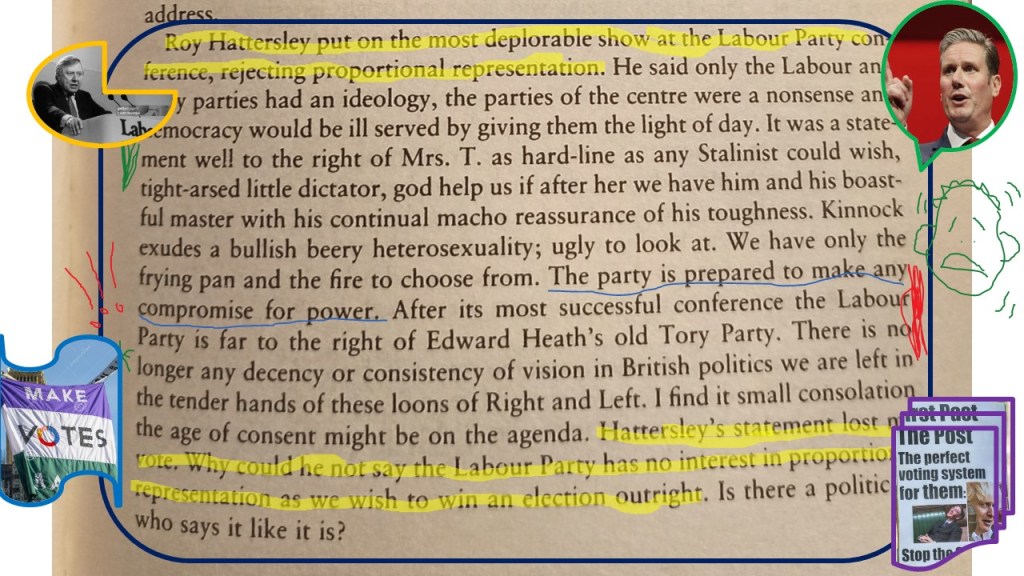
Based on an extract from Derek Jarman’s book, Modern Nature, published in 1992 by Vintage (p163).
Reading Derek Jarman’s ‘Modern Nature’, I was jolted out of reflections on plants, art, life and death by his sudden and surprisingly vehement condemnation of the Labour Party’s rejection of proportional representation at the Labour Party conference in 1989. I had no idea Derek Jarman cared so much about proportional representation. But then, why wouldn’t he?
During the 2022 Labour Party conference I was in Liverpool town hall’s wonderful council chamber for a Compass event on finding new ways to do politics, when there was suddenly huge excitement in the room. The conference delegates, in another part of the city, had just voted in favour of proportional representation (PR). Specifically, they had voted for the party to change the voting system for general elections to a form of PR in Labour’s first term in office and to convene an ‘open and inclusive process’ to decide the specific PR voting system it will introduce. Incredible! Proportional representation was an issue that I had come to feel passionately about as I saw the disaster that the First Past The Post (FPTP) system had created for our country – almost total distrust in and alienation from our political system (to borrow a phrase from Keir Starmer). Tory governments had been using their Commons majority to force through measures that served to reduce the power of the courts and Parliament so that the government could do whatever it wanted, and it seemed that we were all powerless to do anything about it. As I learned more, it seemed to me that FPTP was a part of the problem, and moving to a system that better reflects the views of all voters, and facilitates engagement, discussion and consensus, would go a long way towards shifting the tone of our political system.
So the fact that the Labour Party membership had voted in favour of a PR policy seemed like a huge leap in the right direction. Clearly, anybody who has any understanding at all of the party political system in the UK (which I didn’t) can see what is coming next. The fact that the Labour Party membership is in favour of a policy does not, I discovered, mean that this will become Labour Party policy. It is Labour’s national policy forum and ‘Clause V’ meeting before an election that decides which parts of the party programme are included in the manifesto. And PR had no chance of being in there – and still doesn’t. Keir Starmer has consistently said that he is not in favour of PR and electoral reform is not going be a priority of his government. Although he notes that many people feel their votes don’t currently count and that the Westminster system is part of the problem. He’s right on both counts. A poll in June 2024 found that a majority of Labour voters (along with majorities of Green, Lib Dem and, ahem, Reform voters) want a shift to PR.
To resolve some of the biggest issues of our time like climate change, inequality and social inclusion we need a political system that truly facilitates and incentivises collaborative decision-making. Our outdated and damaging current voting system hinders much-needed progress by propping up a two-party system that limits diverse representation and bakes instability into our policy landscape, perpetuating the multitude of crises facing our nation.
As is often the case when we start to think we are living in unprecedented times, something comes along to remind us that, in fact, no, we have been here before. Derek Jarman’s contemptuous comments on the Labour Party of 1989 wouldn’t need much editing to be re-published as a commentary on the Labour Party of 2024. The Labour Party leadership know that FPTP has benefited their party, and has done so since the Labour Party supplanted the Liberals in the two-party system (Herbert, 2024), and so intend to stick with it despite being equally aware that it doesn’t benefit the country.
In 1989 Derek Jarman wrote, ‘The party is prepared to make any compromise for power … Hattersley’s statement lost my vote. Why could he not say the Labour Party has no interest in proportional representation as we wish to win an election outright?’ We could ask the same question 35+ years later.
No proportional voting system is as flawed as First Past the Post, and good systems of Proportional Representation – which have a strong constituency link, enhanced voter choice and accountable representation – are incomparably better.
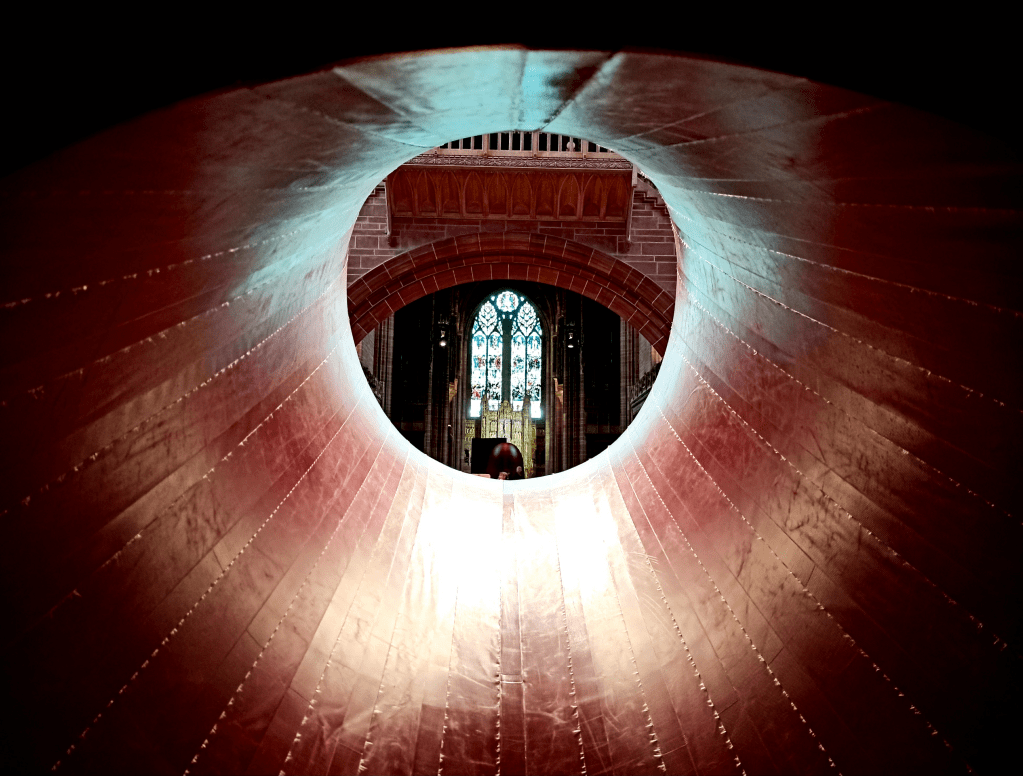
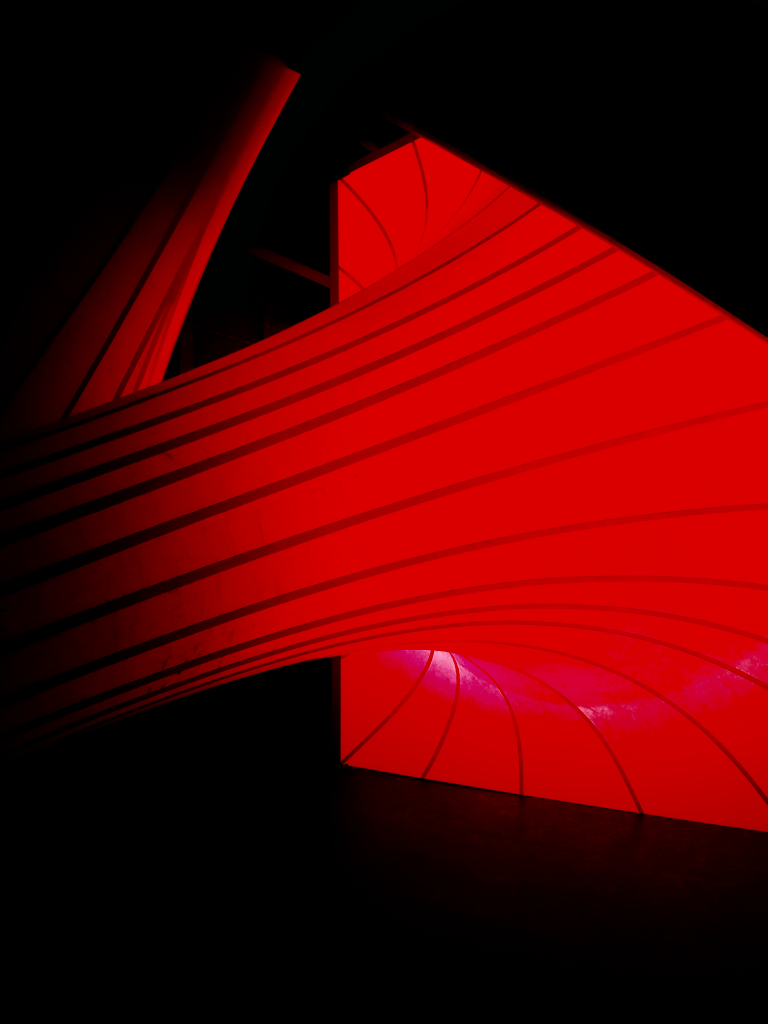
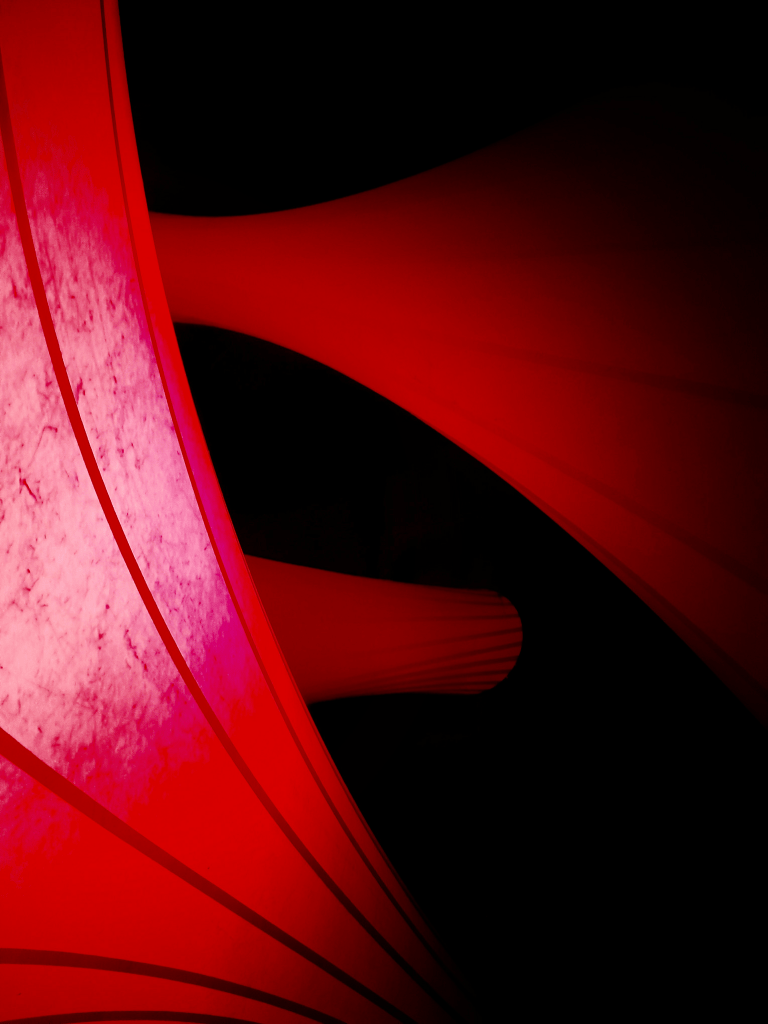
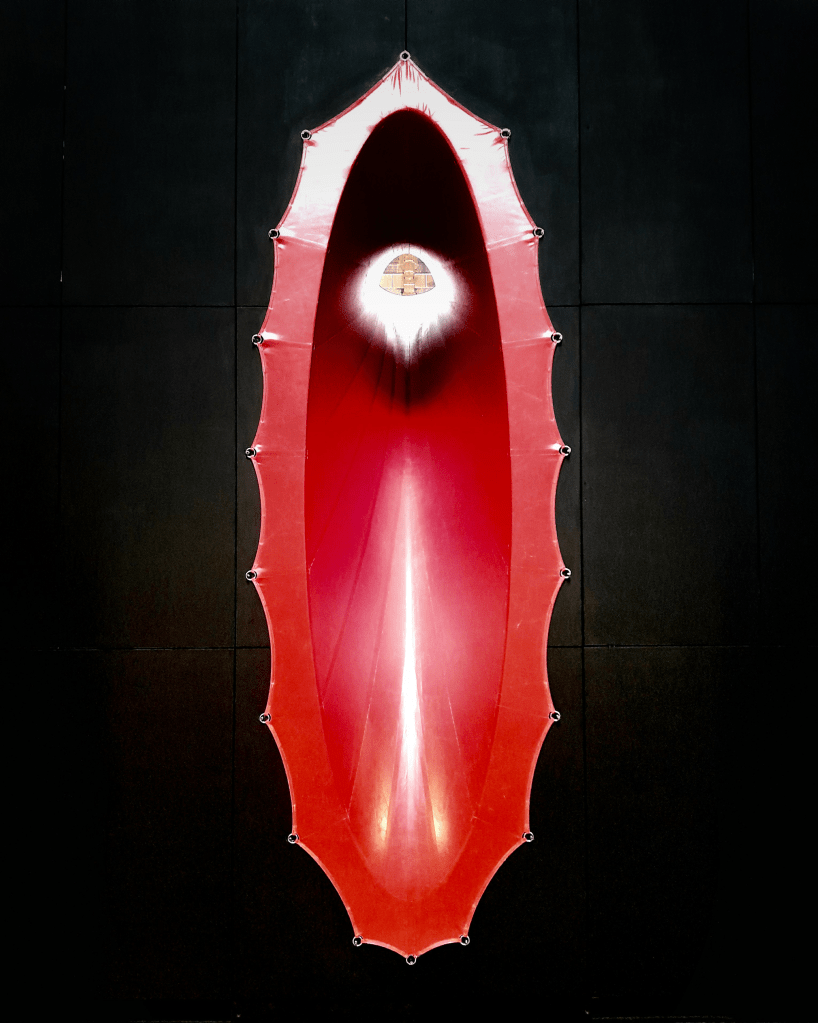
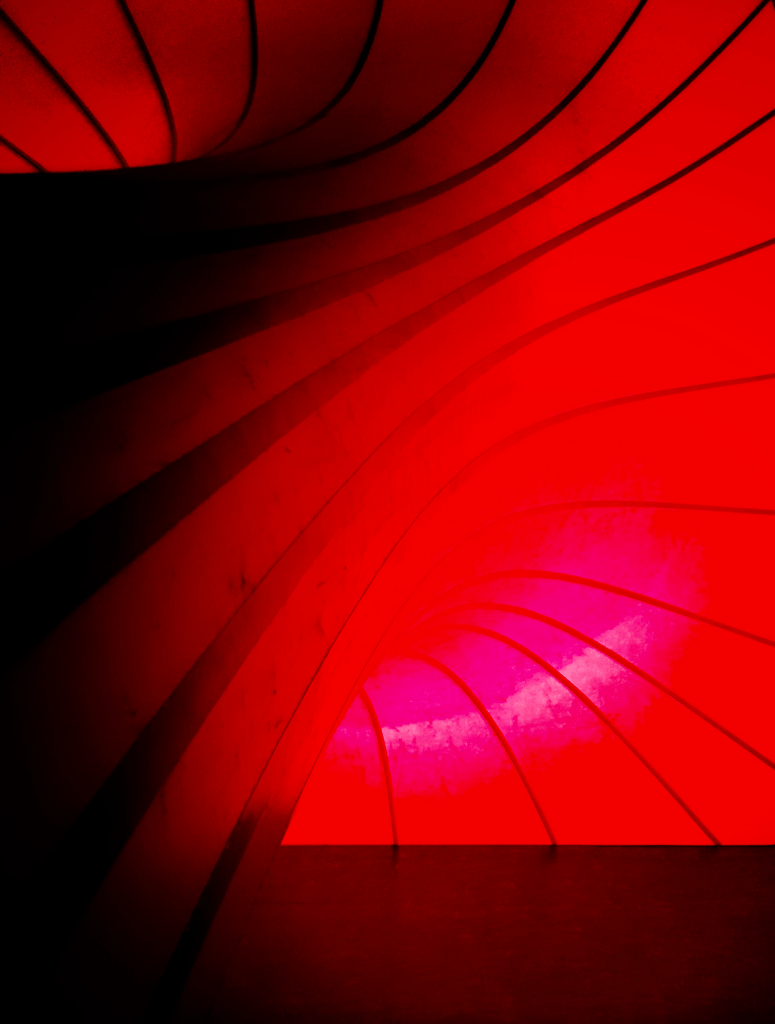
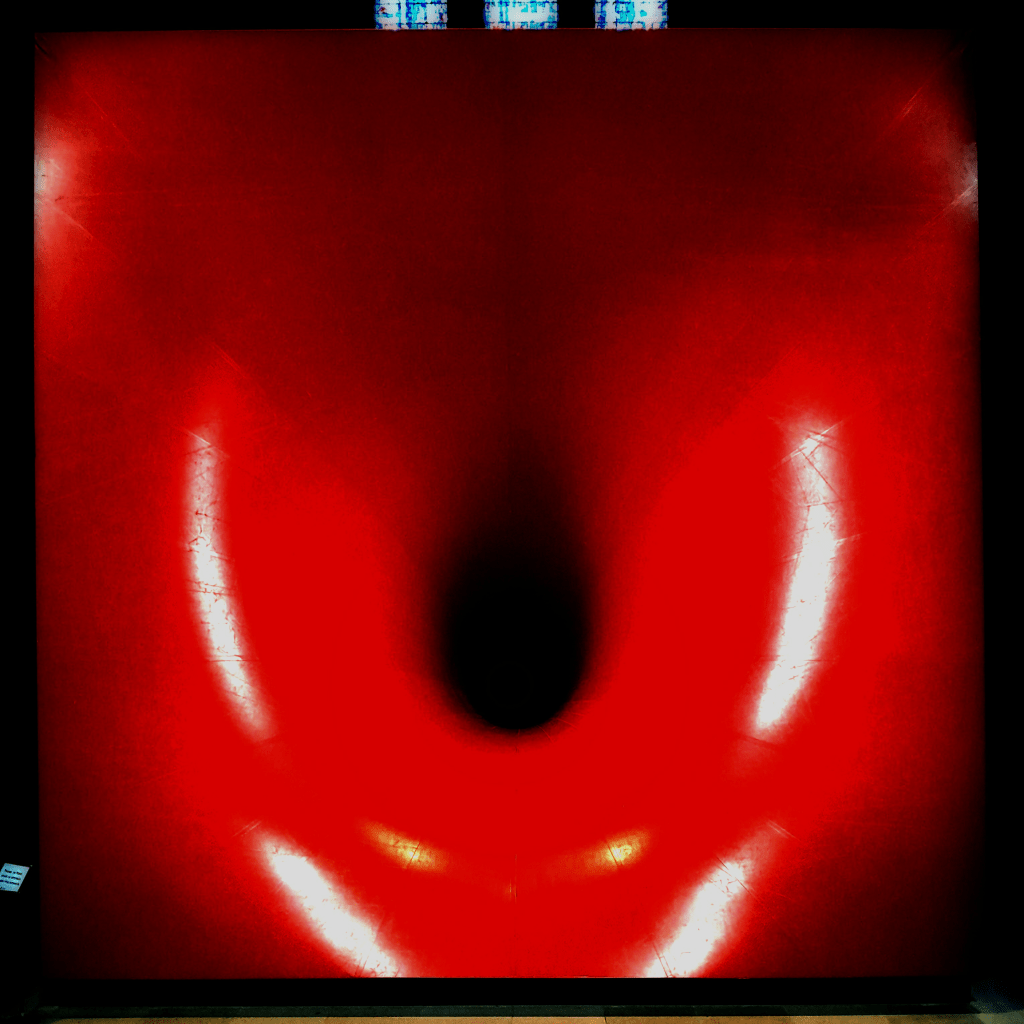
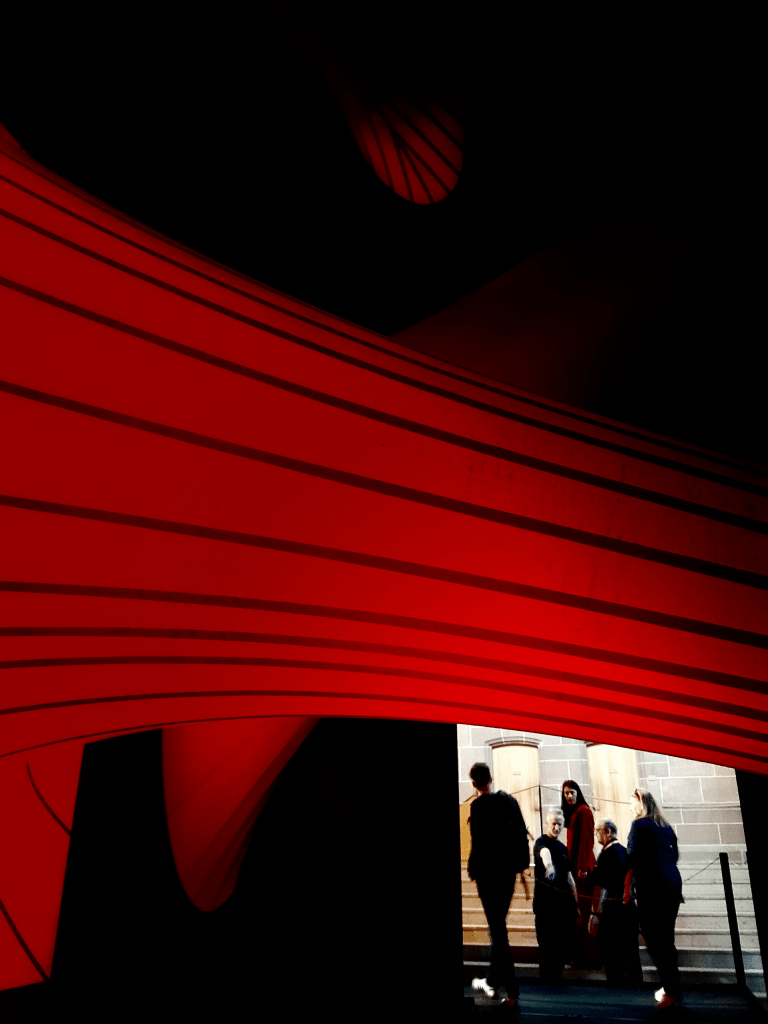
A collage of thoughts inspired by our photos of Anish Kapoor’s ‘Sectional Body preparing for Monadic Singularity’ at Liverpool Cathedral, August 2024.
This post is a collaboration with DC who took the photos and explored ideas with me.
A huge black and red box, light and shadows created by the sun pouring through the cathedral’s stained glass. There is something organic about it. There are apertures and openings, curves and vessels. Some of the holes go all the way through the object. The light comes through the top circle of the church window, the colours of the stained glass blown out by the burst of natural light streaming in, landing perfectly on the orifice of the structure.
There is a vagina, somehow pinned open in a way that seems obscene, exposing the opening. It is shiny, glossy and perfect. And light is pouring through the opening. Divine light, love and grace is pouring down from the glorious zone above the vagina, the zone of pleasure, pouring down, dripping onto our humanity. This is real light, the sun’s light coming from 94 million miles away, through our magnetosphere, through the stained glass of the cathedral, to land on the stretched plastic of this curve here.
This structure celebrates and glorifies the site of the birth of all things, the essential and divine function. This is not out of place in a church. This is the site of our pleasure and our birth. The thing that is born is the thing that has the capacity to love and be loved.
Kapoor has spoken of the void as a space filled with potential, not emptiness
Inside the box, it feels as though there are stylised versions of bodily organs flowing around me. There is symmetry within the body of the box; the seams and ribs of the vessels curve. Light is moving and spreading through the vessels. From the outside it seems to be a singular perspective, and then when I’m inside I become aware that there is more going on.
There are juxtapositions and contrasts between the rigidity of the box and the voluptuous slitheriness of the contents of the box. Another contrast with the cathedral setting – the hard, bunter red of the stone and the glittering multiplicity of the stained glass windows. One photograph has people in it, and this creates another contrast. There is a gateway to reality. There is an abstract box and there are lives going on here.
The black box is holding secrets, a record of what has happened. It could become sentient – this is the singularity. If we think the singularity is something in the future and something to be fearful of, this work might suggest to us that it’s something that has already happened, and that’s why we’re here. We’re fearful of something that we’re already part of. The thing we’re looking for outside ourselves, perhaps a spiritual connection, is already within us.


 Unfurl /ŭn-fûrl′/