A letter to my friend who has given up her job to become a freelance yoga teacher

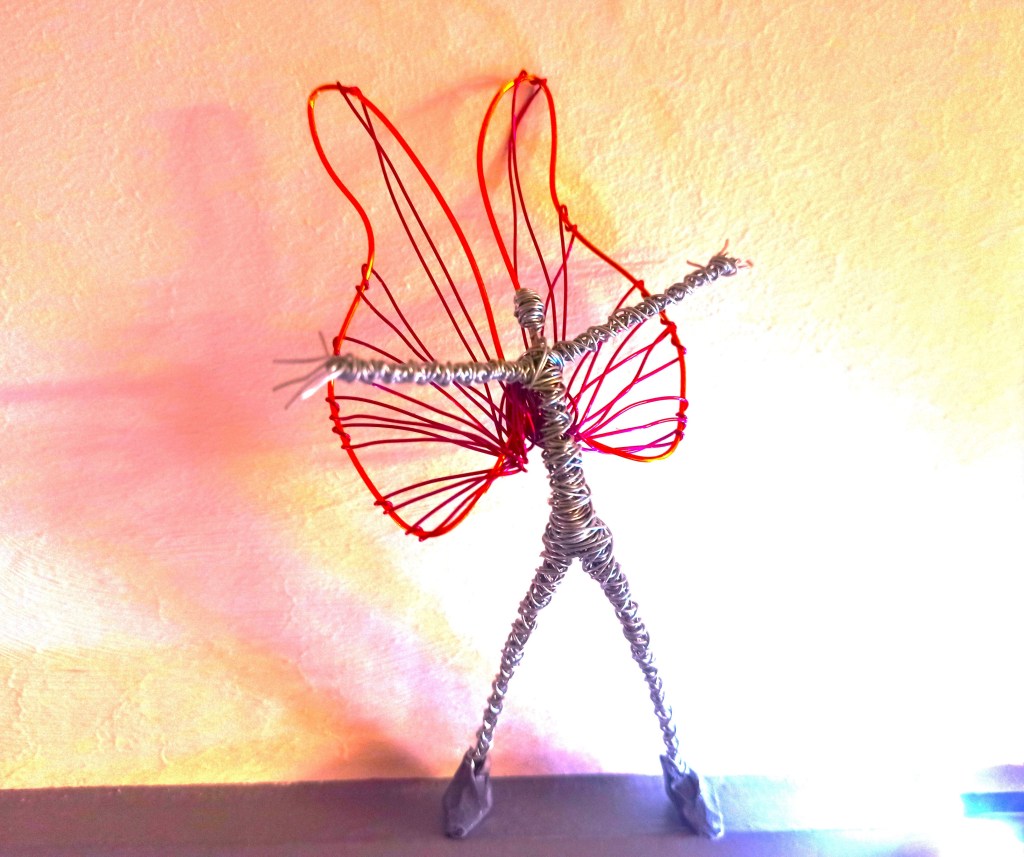
Exuberant wire figure I bought myself to celebrate my 50th birthday

I woke up thinking about you today. It’s a courageous and wonderful thing you’re doing. I can’t imagine you will look back one day and think ‘I wish I’d stayed in that job’. Going freelance turns us into a different type of being, one that there’s no going back from, in my experience.

I woke up thinking about you, but really I was thinking about me. I was remembering the time in 2009 when I decided to give freelance life a go. I was in a different position to you – I’d left my job (and everything else) six years earlier to go and work in a refugee camp. After three years there, and a year working in another overseas job, I came home to the UK and s short-term research fellowship. When that ended, my intention was to get a job in the UK, settle down and build a life having got ‘all that’ out of my system. But I was free – I had nothing and no-one, and it turned out that it was quite difficult to give up that freedom. Also, it was the best chance I had to try working as a freelance Mental Health and Psychosocial Support (MHPSS) specialist. I had nothing to lose.

The first few months were terrifying. I had no work. I spent my days scouring Reliefweb for consultancy projects I might have a chance of getting, going for long runs around Edinburgh and doing yoga. I’d never been so thin or so healthy. Work started coming but the fear didn’t leave. Over the first six or seven years there were periods of no work and no prospect of work. I realised that Jan/ Feb were particularly dry months. I spent the start of several years in a panic that I would never work again – until I did, of course.

Now, 15 years later, it’s different. I do less work and get paid more for it. I only work with people I know and like, people and organisations with values aligned with my own. Mostly I don’t need to look for work – it comes to me. It’s a wonderful position to be in, but it’s taken years to get here. Years of no work, too much work, the wrong kind of work and hardly any life outside of work. This isn’t something I wish for you, but I wouldn’t wish away those years for myself. In fact, they have given me one of the greatest gifts of my freelance life – the confidence that work will always come. This confidence remained despite the loss of all my work when the Covid pandemic hit and I wasn’t able to travel. I was back to scouring Reliefweb for consultancy work I could do remotely, sending off applications that I never heard back from. Until finally one was successful, and I was off again.

My work has changed since then. I don’t want to work as much, and I’m certainly not going back to the impossible travel schedule I had before. But I won’t be giving up the freelance life. It has changed me and I can’t change back. You leaving your job has prompted me to think about what the freelance life brings that I value so much.

‘There is a vitality, a life force, an energy, a quickening that is translated through you into action, and because there is only one of you in all of time, this expression is unique. And if you block it, it will never exist through any other medium and it will be lost. The world will not have it. It is not your business to determine how good it is nor how valuable nor how it compares with other expressions. It is your business to keep it yours clearly and directly, to keep the channel open’.

Martha Graham

Above all, it’s the ability to be true to myself in my work life. Certainly, I’ve compromised in the past, doing jobs that didn’t feel right and perhaps, with hindsight, I should have withdrawn from. But I went into them for the right reasons, believing that the work had value and would contribute to the overall good. That is a privileged position to be in, and not something I would give up easily.

I also love the buzz of the new. A new opportunity, new things to learn, new people to meet.

I love the wide wide network of people I’ve worked with and connected with, all over the world. I’ve met some incredible people and great friends.

I like that even if a job doesn’t work out the way I expected, there’s a natural end to it. Lessons learned, move on.

Every day is different. I don’t know what I’ll be doing in two months’ time, never mind in a year or five years, and I love that! The future feels open and exciting.

The lifestyle really suits me. I love new challenges, learning, novelty and the pressure of having to produce something quickly and well. I love the negotiation and keeping everybody on board with where the project is going.

But more than anything, I love the person I’ve become through 15 years of freelance life. It has been liberating. I wish you the same.
Derek Jarman on Proportional Representation

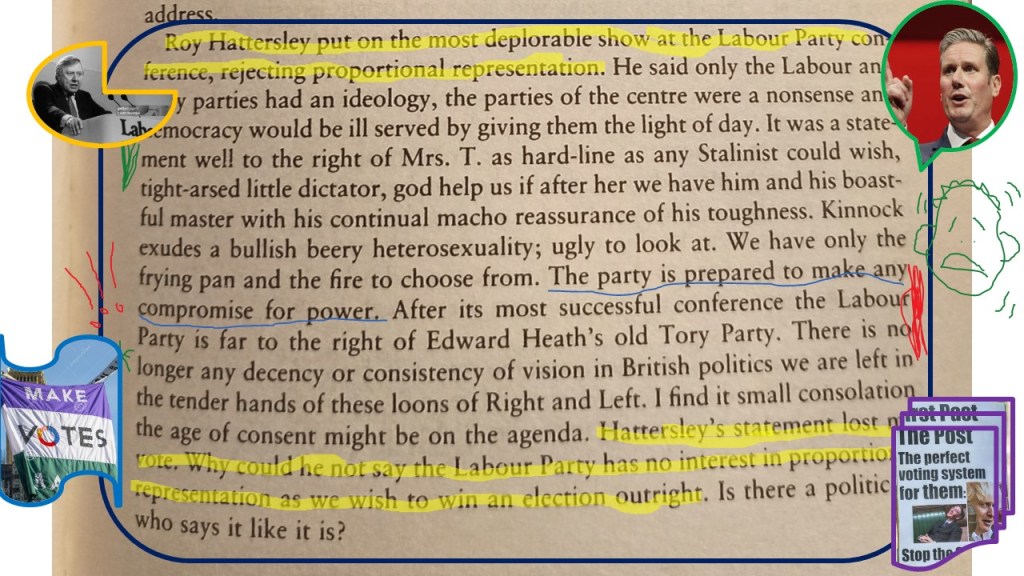
Based on an extract from Derek Jarman’s book, Modern Nature, published in 1992 by Vintage (p163).

Reading Derek Jarman’s ‘Modern Nature’, I was jolted out of reflections on plants, art, life and death by his sudden and surprisingly vehement condemnation of the Labour Party’s rejection of proportional representation at the Labour Party conference in 1989. I had no idea Derek Jarman cared so much about proportional representation. But then, why wouldn’t he?

During the 2022 Labour Party conference I was in Liverpool town hall’s wonderful council chamber for a Compass event on finding new ways to do politics, when there was suddenly huge excitement in the room. The conference delegates, in another part of the city, had just voted in favour of proportional representation (PR). Specifically, they had voted for the party to change the voting system for general elections to a form of PR in Labour’s first term in office and to convene an ‘open and inclusive process’ to decide the specific PR voting system it will introduce. Incredible! Proportional representation was an issue that I had come to feel passionately about as I saw the disaster that the First Past The Post (FPTP) system had created for our country – almost total distrust in and alienation from our political system (to borrow a phrase from Keir Starmer). Tory governments had been using their Commons majority to force through measures that served to reduce the power of the courts and Parliament so that the government could do whatever it wanted, and it seemed that we were all powerless to do anything about it. As I learned more, it seemed to me that FPTP was a part of the problem, and moving to a system that better reflects the views of all voters, and facilitates engagement, discussion and consensus, would go a long way towards shifting the tone of our political system.

So the fact that the Labour Party membership had voted in favour of a PR policy seemed like a huge leap in the right direction. Clearly, anybody who has any understanding at all of the party political system in the UK (which I didn’t) can see what is coming next. The fact that the Labour Party membership is in favour of a policy does not, I discovered, mean that this will become Labour Party policy. It is Labour’s national policy forum and ‘Clause V’ meeting before an election that decides which parts of the party programme are included in the manifesto. And PR had no chance of being in there – and still doesn’t. Keir Starmer has consistently said that he is not in favour of PR and electoral reform is not going be a priority of his government. Although he notes that many people feel their votes don’t currently count and that the Westminster system is part of the problem. He’s right on both counts. A poll in June 2024 found that a majority of Labour voters (along with majorities of Green, Lib Dem and, ahem, Reform voters) want a shift to PR.

To resolve some of the biggest issues of our time like climate change, inequality and social inclusion we need a political system that truly facilitates and incentivises collaborative decision-making. Our outdated and damaging current voting system hinders much-needed progress by propping up a two-party system that limits diverse representation and bakes instability into our policy landscape, perpetuating the multitude of crises facing our nation.

Make Votes Matter

As is often the case when we start to think we are living in unprecedented times, something comes along to remind us that, in fact, no, we have been here before. Derek Jarman’s contemptuous comments on the Labour Party of 1989 wouldn’t need much editing to be re-published as a commentary on the Labour Party of 2024. The Labour Party leadership know that FPTP has benefited their party, and has done so since the Labour Party supplanted the Liberals in the two-party system (Herbert, 2024), and so intend to stick with it despite being equally aware that it doesn’t benefit the country.

In 1989 Derek Jarman wrote, ‘The party is prepared to make any compromise for power … Hattersley’s statement lost my vote. Why could he not say the Labour Party has no interest in proportional representation as we wish to win an election outright?’ We could ask the same question 35+ years later.

No proportional voting system is as flawed as First Past the Post, and good systems of Proportional Representation – which have a strong constituency link, enhanced voter choice and accountable representation – are incomparably better.

Make Votes Matter